Cultivating our capacity to learn, adjust and act together.

Approach

My vision : 

Learning, a force that helps us live better, act together and care for our world.

My mission:

Across organisations and schools, I design and facilitate learning experiences that cultivate human capacities and help groups learn, work and flourish together.

My conviction:

Learning means changing. But change does not simply mean reacting to a constantly shifting world. It means cultivating our capacity to learn together, remain attentive to what matters, and open up new possibilities for action.

+ Read more

Learning means changing. But change does not simply mean reacting to a constantly shifting world. It means cultivating our capacity to learn together, remain attentive to what matters and open up new possibilities for action.

In a world marked by uncertainty, interdependence and constant fluctuation, knowledge alone is no longer enough.

We also need the deeply human capacities that help us navigate complexity, relate more consciously and act with others.

The Inner Development Goals help name many of these capacities. Olivier Hamant’s work on robustness helps us understand why they matter: not simply to perform better, but to remain capable of learning and acting when conditions become unstable.

This leads me to a central question:

How do these capacities become lived, practised and available in the moments when they matter?

When systems ask for change but reproduce old reflexes

Across schools, organisations and cultures, I have kept observing the same paradox:

People often know what needs to change, yet still struggle to move forward together.

Learning does not become blocked simply because of a lack of effort.

It also becomes blocked when people are asked to evolve within systems designed for stability, predictability and efficiency, while today’s world requires greater adaptability, exploration and cooperation.

We try to develop new capacities within environments that continue to reproduce old reflexes.

At school,
we ask for curiosity
but reward conformity.

At work,
we call for collaboration
but celebrate individual performance.

We speak about transformation,
while continuing to design
for transmission.

And little by little,
we exhaust ourselves
trying to change
while the framework around us remains unchanged.

The same tension runs through people and systems:

How can we respond to what is happening now while remaining able to learn, adjust and act together over time?

Learning happens in context

Learning is not only about knowing more.

It is also about becoming more able to notice, adjust and respond to what happens without losing sight of what matters.

Learning is not only a question of content.

It is also a question of context:

relationships,
dynamics,
meaning.

What shapes learning is not only the system or the content, but also the way people relate to them:

to themselves,
to one another,
to what they are learning,
and to the wider world around them.

Human capacities do not develop through information alone.

They take shape through experience, practice and the dynamics we repeatedly live.

What happens within us, between us and around us influences how we perceive, relate and respond.

Behind every learning process, a dynamic unfolds between people, ideas, emotions and context.

When that dynamic is alive, knowledge can deepen and relationships can grow stronger.

But when uncertainty or tension appears, content alone is no longer enough. Familiar reflexes can take over, and the dynamics shaping the situation become more visible.

When tension makes the invisible visible

A misunderstanding.

A difficult conversation.

A loss of engagement.

A decision that no one knows how to make.

A familiar pattern that keeps repeating.

These moments are not simply problems to eliminate.

Tension is information about the dynamics shaping the situation.

It can reveal assumptions, protective reactions, relational patterns and contradictions that were already present but remained unnoticed.

These moments are not interruptions to learning.

They are often where learning begins.

But only when we can remain attentive to what is happening rather than reacting automatically or rushing towards a solution.

Before we can respond differently, we need to notice what is already shaping our response.

Inner Development Goals

WHAT ARE MY FOUNDATIONS?

In a world shaped by uncertainty, interdependence and rapid transformation, the way we learn must evolve. Learning can no longer be limited to acquiring knowledge or technical skills. It must also cultivate the human capacities that enable us to notice what is happening, connect with others, adjust and act together.

The Inner Development Goals (IDG) framework provides the shared language for my approach. It offers a way to name and share some of the capacities that support growth and transformation: self-awareness, curiosity, perspective-taking, courage, cooperation and meaning-making.

My work explores how these capacities become lived, practised and available in the moments when they matter most.

My approach is both integrative and dynamic.

It is integrative because it connects learning sciences and embodied cognition, lived experience and perception, emotions, behavioural and relational dynamics, and systems thinking.

It is dynamic because our capacities do not express themselves in the same way in every situation. They evolve according to what is happening within us, between us and around us. They may become more accessible, but they can also become less available under the influence of pressure, habits, relationships or context.

These different perspectives are not simply placed alongside one another. They help me understand learning as a process that unfolds simultaneously:

within us, through our sensations, emotions, perceptions and representations;

between us, through our interactions, silences, disagreements and ways of cooperating;

around us, through the cultures, systems and living environments that shape how we perceive, relate and act.

Gabrielle Halpern’s work on hybridity also informs the way I create bridges between worlds that are often kept separate: education, work and society; body and mind; inner life and action; the individual and the collective.

Olivier Hamant’s work on robustness illuminates another essential dimension of my approach. Robustness is not simply about resisting or adapting. It is the capacity to continue learning, adjusting and acting when conditions fluctuate.

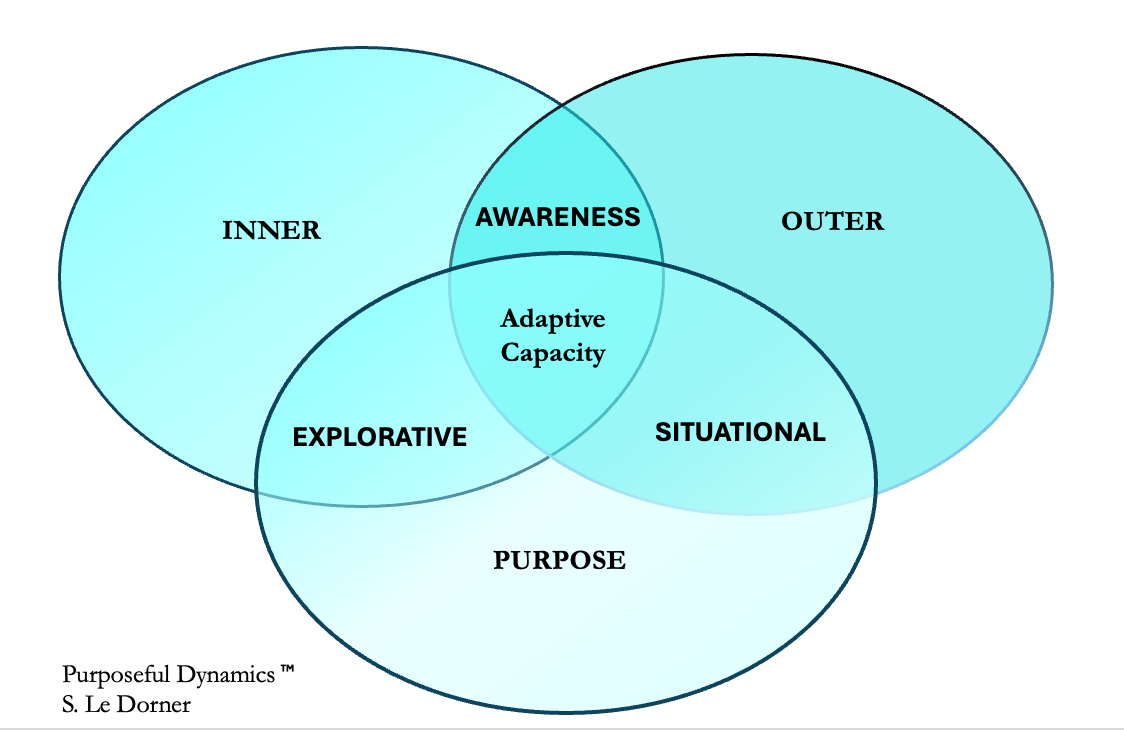
Purpose gives direction to this process. It is not about controlling what should emerge, but about remaining attentive to what matters in the way we perceive, choose and act.

It is at the intersection of these dimensions that Learning in the Flow of Life comes to life: a living approach to learning, rooted in the situations, relationships and contexts through which we move.

HOW LEARNING COMES TO LIFE?

Learning comes alive in ordinary situations: a moment of tension, a hesitation, a difficult conversation, a silence, a question or a choice that needs to be made together.

These moments matter because they often make visible dynamics that had previously been operating unnoticed.

This is where Purposeful Dynamics™ comes in.

Purposeful Dynamics™ is an approach to designing learning experiences and micro-interactions that helps people notice what is happening, make sense of it together and open up new possibilities for action.

Purposeful means designing the conditions for learning with a clear intention, while remaining open to what emerges. Dynamics reminds us that our capacity to perceive, feel and act is continually shaped through our relationships with others and with the context.

This practice engages the senses, the body, emotions and thought. It enables us to work with what is happening within us, between us and around us.

Micro-sensing capsules are brief experiential practices introduced in the midst of action. They invite people to notice a sensation, a shift in energy, a reaction, a need or a relational dynamic before habitual responses take over completely.

They are not simply pauses designed to calm people down.

They create a small space in which another perception, interpretation or response can become possible.

Before we can choose differently, we often need to notice differently.

A shared language then helps people name what they are experiencing, recognise what they have in common and where they differ, make dynamics visible and understand together what is unfolding.

But words alone are not enough.

Learning truly takes shape when people experience another way of perceiving, relating and acting.

Each capsule can then introduce a micro-shift:

  • curiosity becomes exploration;
  • perspective-taking becomes dialogue;
  • reflection becomes adjustment;
  • intention becomes grounded action.

Over time, these experiences help cultivate human capacities, exercise them and make them more available in real-life situations.

A micro-shift does not transform a system on its own. It can, however, reveal a contradiction, open up a necessary conversation or make it possible to experiment with another way of acting.

Learning therefore extends beyond the immediate context. What is noticed or experienced in a classroom, a team or an organisation can travel into other spaces and contribute to changes in practices, relationships and structures.

Learning in context and in real time means working at the heart of the situations in which our capacity to perceive, adjust and act together is truly put to the test.

Five capacities to evolve the way  we learn, cooperate, and act together. 

Let’s bring them to life!

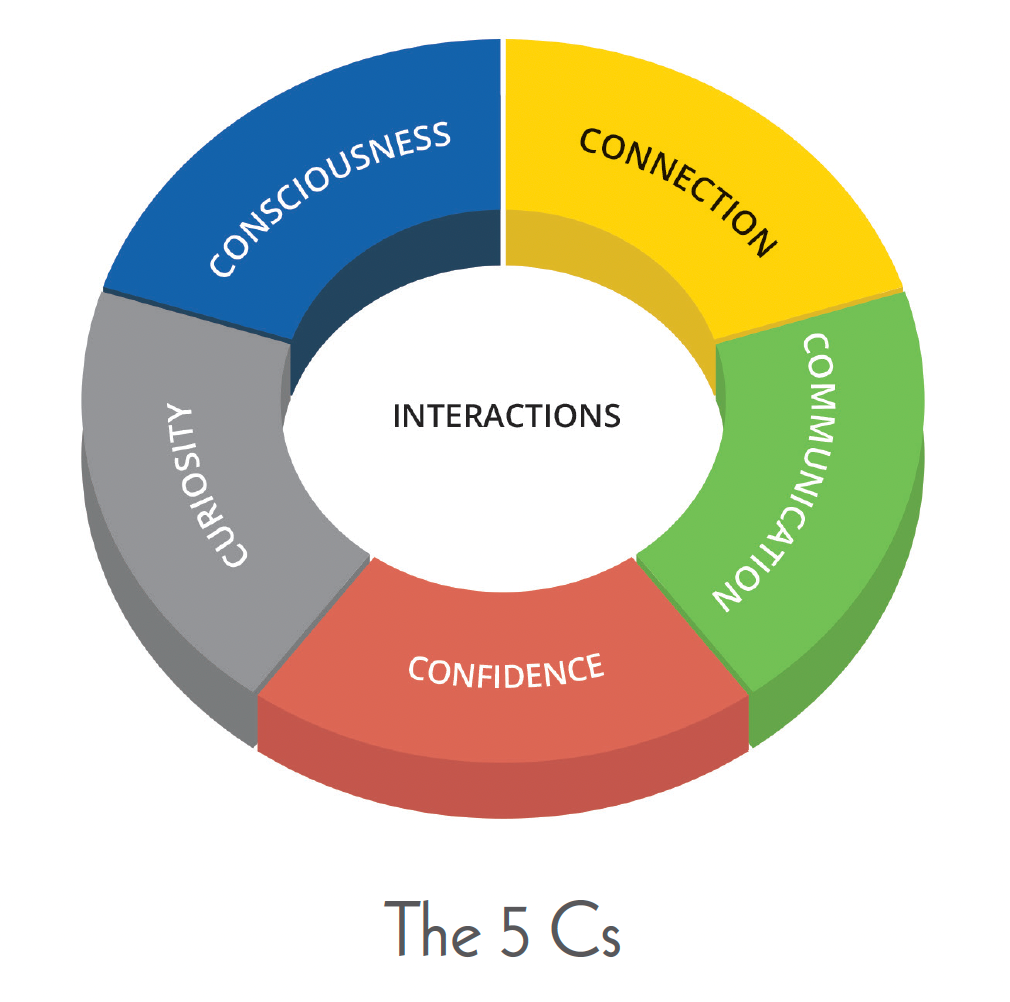
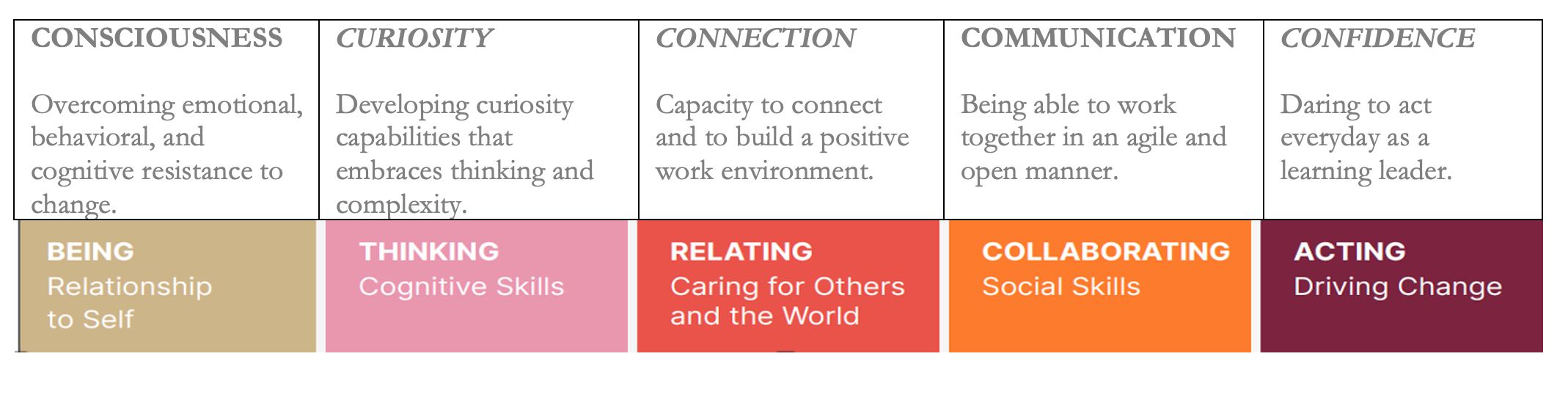
Every group can strengthen its capacity to learn, adjust and act together by cultivating five key capacities.

The 5Cs are my way of translating the Inner Development Goals into a living practice. They offer a shared language for noticing what is happening, relating to one another and navigating complexity — in schools, teams and beyond.

By cultivating Consciousness, Curiosity, Connection, Comunication and Confidence, groups become better able to understand their dynamics, engage with uncertainty and open up new possibilities for meaningful action together.

Consciousness: Embracing uncertainty, from reacting to relating.

Welcoming uncertainty means stepping out of automatic reactions and staying connected to what is happening — within ourselves and with others.
By developing embodied awareness (sensations, emotions, interpretations), we make our patterns visible and regain the ability to choose.
It is within this presence, both individual and relational, that new possibilities for action and growth can emerge.

Curiosity: Thinking in ambiguity, from relating to exploring.

Curiosity keeps us open in complex environments.
By questioning our assumptions and blind spots, we move from what we believe we see… to what we can explore. This is how we learn and remain in motion in the face of uncertainty.

Connection: Embracing diversity, from exploring to co-creating.

Connection grows through active listening, empathy, and compassion.
By exploring our differences, we learn to relate in new ways and co-create dynamics where everyone finds their place.
It is within this space that we grow together and nurture a true collective drive for learning. We move from simply understanding differences to being able to act together with them. Differences no longer divide us — they become resources to adjust, align, and build together.

Communication: Expressing with clarity, from co-creating to collective progress.

Communication shapes the way we learn together.
Through open and adaptive interactions, we share perspectives, clarify what matters, and give direction to collective action. We move from intention to momentum. What emerges together becomes actionable, enabling the collective to move forward with greater fluidity and alignment.

Confidence - Daring to act together, from collective progress to flourishing.

Confidence emerges when we dare to take a step, express an intention, and act together. It is built through experience, as each person finds their place and contributes to the collective movement. From progress to flourishing, we move from action to a sustainable dynamic where everyone can engage, grow, and contribute fully. This is how the collective becomes both strong, alive, and capable of evolving over time.

AS FEW OF MY TOOLS

What about a tool for deep reflection on the mechanisms of thinking and learning? 

A phenomenological approach developed by Antoine de La Garanderie, focuses on understanding and improving cognitive processes. This method involves identifying and analyzing the mental gestures that individuals use to learn and solve problems. By making these cognitive processes explicit, it helps individuals develop more effective learning strategies and improve their mental efficiency. It emphasizes the role of conscious mental actions in learning, aiming to optimize how individuals think and learn.

What about an intuitive tool to develop behavioral skills?

A tool created by BRIGITTE BOUSSUAT based on Jung's and Marston's work on human behavior (4Colors®). 

Each individual is a unique blend of 4 different behavioral styles, represented by 4Colors®, for a more intuitive understanding. The 4 colors interact with each other and the blend of the 4Colors® will reflect different ways you may approach relationships to others, changes, problems and constraints. The 4Colors® profile will allow you to navigate the world of communication and identify the color of the person you are engaged with.

+ info

What about a pedagogy that makes learning fun?

A Pedagogy created by BRIGITTE BOUSSUAT and JEAN LEFÈBVRE based on the new research on neurosciences (FUN&FFICIENT).

The method relies on 8 pillars: Focusing on the learner, Removing obstacles, Finding or bringing back the fun in learning, Focusing on attention, Playing with emotions, Reinforcing memorization, Connecting head and body, A lifelong learning journey

What about a neuroscience-based coaching that encourages new insights?

An approach created by DAVID ROCK based on the new research on neurosciences.

6 insights that has shaped the approach: The brain is a connection machine No two brains are wired the same The brain sees the world according to its own wiring The brain hardwired everything it can. It's practically impossible to deconstruct our hardwiring It's really easy to create new wiring. The brain-based coaching to connect heart and mind: a non-directive way of learning, “a transformative and co- creative learning adventure. A coaching based on a proven neuroscience methodology that increases the capacity to think more rationally under pressure; to problem-solve and make decisions with more clarity and independence.